
This morning’s sunrise over Anthem — the kind of sky that makes you understand why sailors turned it into a warning.
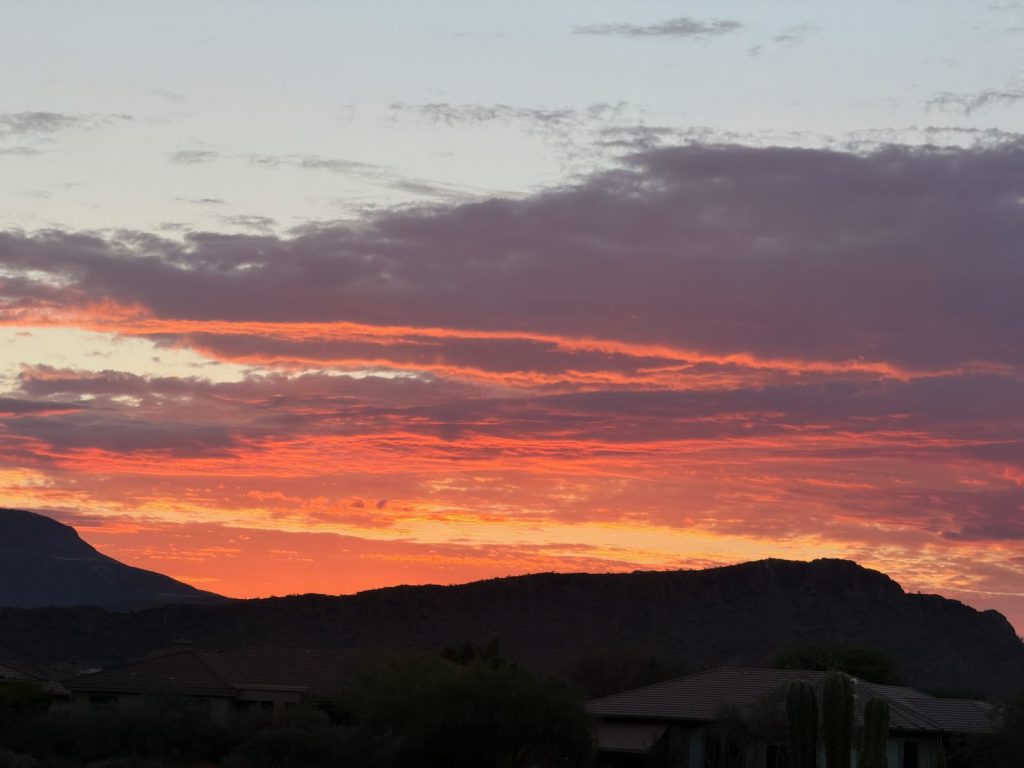
Red sky at night, sailor’s delight. Red sky at morning, sailor’s take warning.
The saying is a lot older than most people assume — over two thousand years old, by most accounts. The earliest written version shows up in the Bible, in Matthew 16:2-3, where it’s quoted as wisdom already common among sailors and farmers of the time.
When evening comes, you say, ‘The weather will be fair, for the sky is red,’ 3and in the morning, ‘Today it will be stormy, for the sky is red and overcast.’ Matthew 16:2-3
It isn’t really about the color itself; it’s about what usually produces that color. A red sky at sunset typically means a high-pressure system, and clearer skies, is moving in from the west. A red sky at sunrise can mean the opposite — that high pressure has already passed to the east, with lower pressure and rain moving in behind it.
Christopher Columbus is sometimes mentioned alongside this lore, and while his logs don’t reference the red-sky rhyme directly, he did put weather-reading to real use. On his fourth voyage in 1502, anchored off Santo Domingo, Columbus recognized signs of an approaching hurricane — an oily swell out of the southeast and a veil of cirrus cloud spreading in from the east, the same kind of pattern he’d learned to respect after an earlier storm in 1495. He asked the colony’s governor for shelter in the harbor and was refused; the governor’s own treasure fleet sailed out anyway. Columbus’s smaller ships weathered the storm on the island’s western side. The governor’s fleet did not: 20 of 30 ships were lost, along with roughly 500 lives.
It’s not the same phenomenon as this morning’s red sky, but it’s the same instinct — reading the sky because it’s telling you something real about what’s coming next.