
I want to bring up a number I haven’t used or mentioned before: New Zealand Index (NZI). NZI is a sea-surface temperature and pressure signal from the ocean northeast of New Zealand, used by some researchers to forecast Southwest winter precipitation. I wrote up the full mechanics in a new encyclopedia entry if you want it. Short version here: warm NZI tends to mean a drier Southwest winter, cool tends to mean wetter.
NZI is not settled science. A UC Irvine-led team proposed it in 2018. A follow-up paper in 2019 pushed back hard on the statistics and the physical mechanism behind it. The original authors replied and defended it. It’s still an open argument in the literature. So, we will add it to the mix, but without a lot of fanfare.
There are two versions of this signal, and they don’t agree on strength. A July through September reading, about a 3-month lead on winter, correlates at roughly -0.55 with Southwest precipitation since 1982. A September through November reading, a 1-month lead, correlates closer to -0.7. We’re using the July-September number here, the weaker of the two.
This year’s reading is warm. 17.31°C, against a 1950-present median of 16.907°C.
So how does that compare to the four analog years (1952, 2003, 2005 and 2024) from the last post, the ones matched on PDO, AMO and ENSO? Here’s how they line up.
| Year | NZI | Signal | Gap from 2026 | Flagstaff Dec–Mar |
|---|---|---|---|---|
| 1952 | 16.73°C | Cool | −0.58 | 12.77″ |
| 2003 | 17.25°C | Warm | −0.06 | 4.72″ |
| 2005 | 17.29°C | Warm | −0.03 | 17.86″ |
| 2024 | 17.58°C | Warm | +0.27 | 9.28″ |
| 2026 (this year) | 17.31°C | Warm | — | — |
For NZI, 2003 and 2005 are about as close a match as you’ll find, both within 0.06°C of this year and both Warm. 2024 runs a bit higher but still Warm, 0.27 off. 1952 is the one that doesn’t fit. It’s Cool, 0.58 off. It’s also the only analog from before 1983, so the correlation itself is weaker for that year on top of the mismatch.
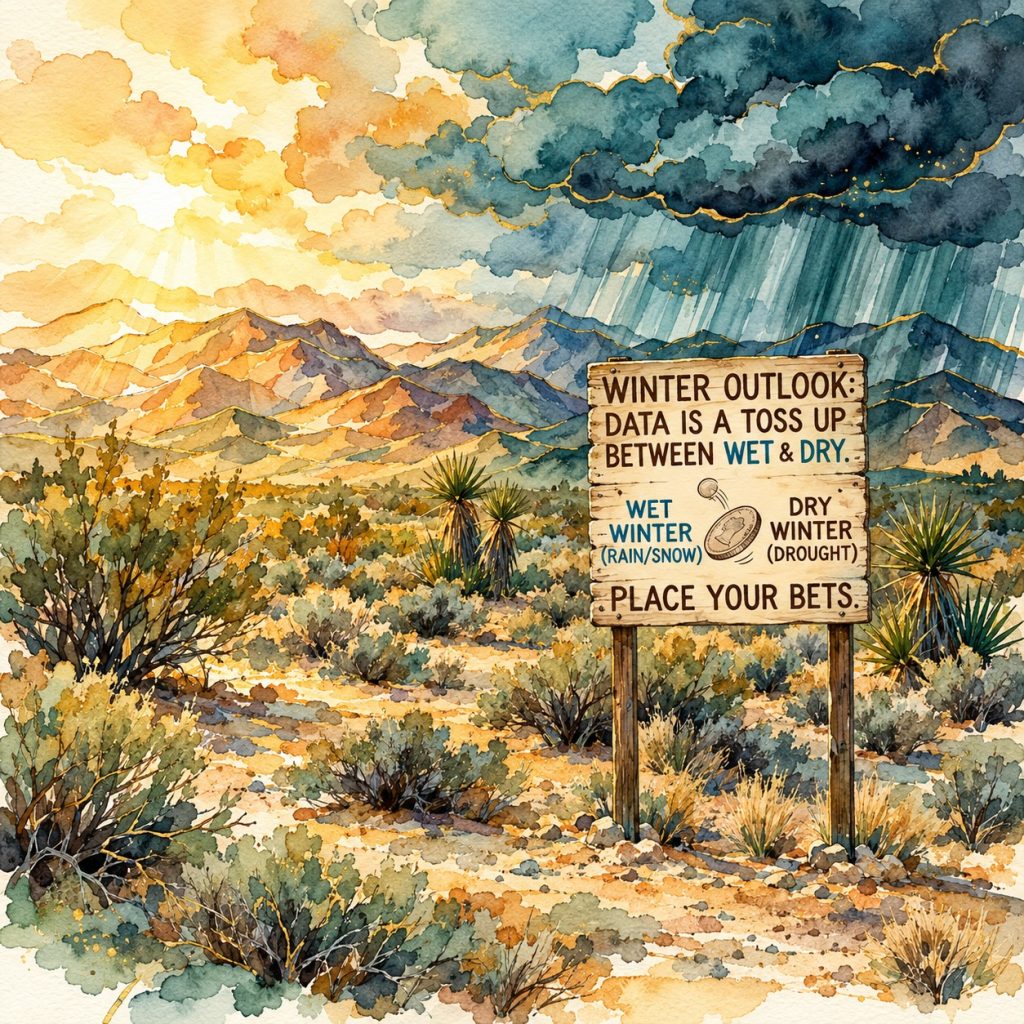
But, look at the difference in precipitation amounts! 2003 is the lowest! 2005 is the highest! And, they were very close together. So on top of everything else, I don’t know how much weight NZI’s signal should even carry this particular winter. Bottom line is that an El Niño year doesn’t guarantee amazing precipitation.